The Autumn Storm at Windsor
In the meticulously manicured universe of the British monarchy, timing is everything. On a brisk, damp morning at Eton College, the nation’s cameras were trained upon a single focal point: Prince George, poised at the threshold of secondary education, embodying the quiet, orderly continuity of the House of Windsor. It was meant to be a masterclass in institutional stability—a visual reassurance that the future of the Crown is secure, focused, and entirely insulated from external turbulence.
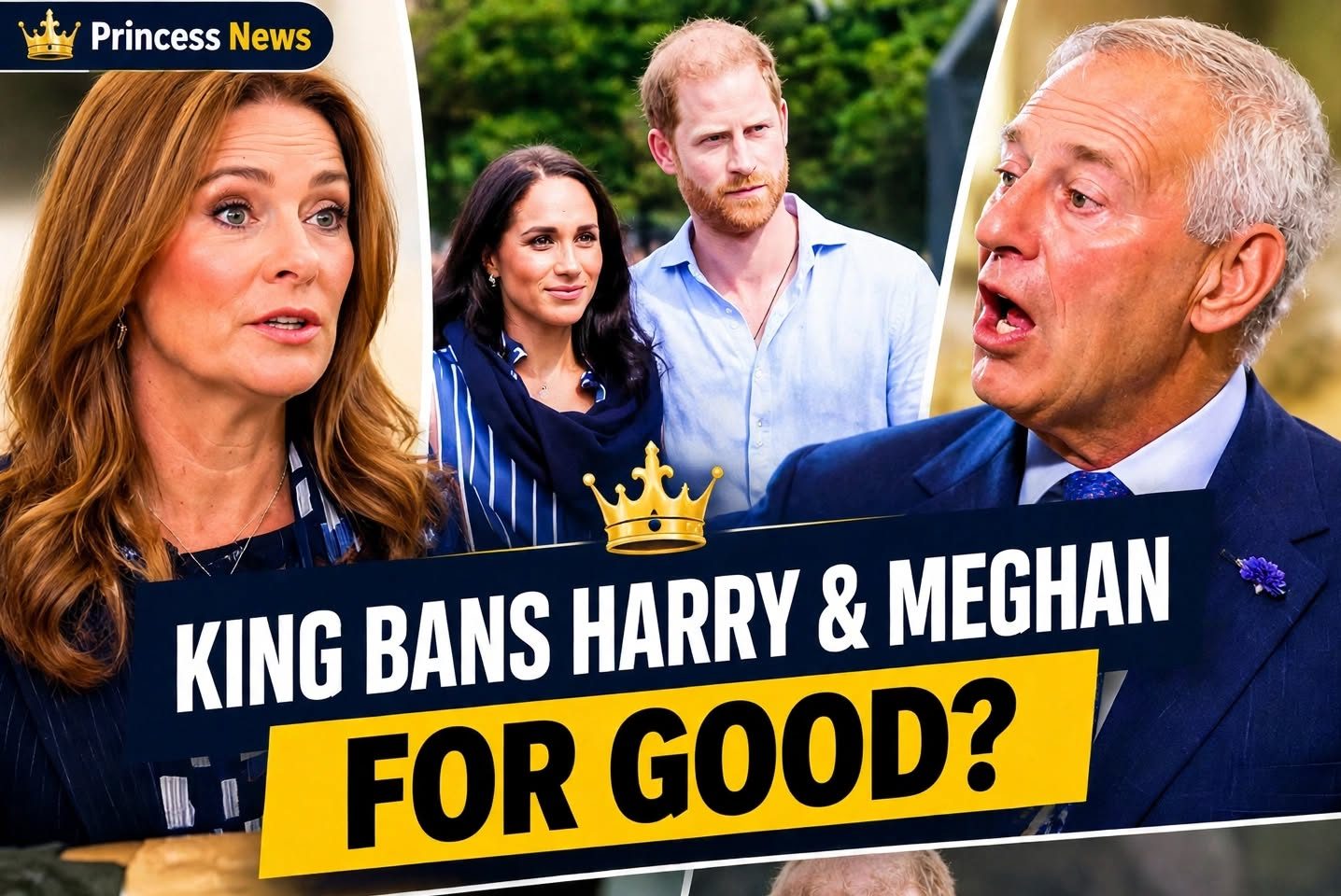
The message was not whispered behind closed doors; it was broadcast with unmistakable clarity. Prince Harry and Meghan Markle are, and will remain, strictly private citizens. The door to any form of working royal re-engagement—whether partial, seasonal, or ceremonial—has been permanently welded shut. For a family that has spent years navigating the murky waters of the Sussexes’ transatlantic departure, this was not merely a boundary-setting exercise. It was an institutional execution of the “half-in, half-out” model, designed to ensure that no amount of public manoeuvring could ever blur the lines of succession and duty again.
Anatomy of a Palace Shut-Down
The document itself, authored under the ultimate authority of the Lord Chamberlain—the most senior administrative officer in the royal household—was surgical in its precision. Dispensing with the diplomatic ambiguities that often characterise royal correspondence, the letter laid bare the stark legal and constitutional reality of the Sussexes’ current standing.
The key passages read with chilling administrative finality: “It follows that there is no change to the current status of the Duke and Duchess of Sussex. Their styles as His and Her Royal Highness remain in abeyance and are not used. The charitable work of the Duke and Duchess is a personal matter for them both and undertaken in their private capacity. In short, their position is akin to private citizens with commercial and charitable interests.”
For Harry, who has consistently argued that his birthright as the King’s son and the brother of the future monarch renders an entirely private existence an impossibility, the phrasing was salt in an unhealed wound. Sources close to the Sussex camp expressed profound shock, noting that the couple received the directive simultaneously with the global press pack, stripped of any familial courtesy or advanced warning. It was a calculated coldness—the unmistakable signature of a monarchy that has transitioned from managing a wayward family member to protecting its corporate and constitutional integrity at all costs.
Why now? Why drop an administrative anvil on a Tuesday morning in September? The timing betrayed a deep-seated anxiety within the palace walls. With the royal family preparing to resume their grueling autumn schedules of state banquets, regional visits, and diplomatic engagements, palace strategists grew increasingly paranoid over the impending return of the Duke and Duchess to British soil. Whispers of upcoming public appearances, charitable ventures, and inevitable media storms threatened to collide directly with the working diaries of King Charles, Queen Camilla, and the Prince and Princess of Wales.
The palace was terrified of optical contamination. If Harry and Meghan were allowed to drift unhindered through local authorities, military barracks, or charitable galas without an explicit, publicly broadcast disclaimer, well-meaning officials might instinctively revert to old protocols—rolling out red carpets, offering police escorts, and treating them with the deference due to working royals. The letter was an insurance policy against collective institutional amnesia.
The Iron Hand of Prince William
To understand the unyielding inflexibility of this decree, one must look past the sovereign’s signature and examine the rising influence of the heir to the throne. Within royal circles, it is an open secret that Prince William has taken an increasingly uncompromising stance regarding his brother. While King Charles has historically wrestled with the paternal guilt of a father watching his youngest son drift into the orbit of American commercialism, William’s calculus has always been starkly institutional.
For the Prince of Wales, the events of recent years—ranging from explosive television interviews and tell-all Netflix series to multi-million-pound memoirs laying bare intimate family grievances—permanently fractured the bond of trust. William’s vision for the modern monarchy leaves zero margin for emotional sentimentality that threatens the stability of the crown. The decision to issue a public, heavy-handed clarification bore all the tactical hallmarks of William’s inner circle: decisive, preventative, and utterly merciless in its execution.
The palace’s anxiety was not unfounded. The Sussexes’ commercial trajectory since relocating to California has relied heavily on the gravitational pull of their royal associations, even as they attempt to carve out an independent corporate identity. The friction point has always been simple: can an individual monetise their royal status while standing outside the institutional tent? King Charles’s letter answers that question with a resounding, legally binding negative. By explicitly categorising their commercial and charitable endeavours as private enterprises, the Crown has effectively severed any financial or operational umbilical cord that might have linked their private business ventures to the prestige of the sovereign.
The Local Authority Quagmire
Beyond the grand theatre of high-level royal politics, the directive served an immediate, highly practical purpose: protecting local government bodies, regional police forces, and municipal leaders from making catastrophic protocol errors.
In the United Kingdom, local authorities, Lord-Lieutenants, and civic leaders are steeped in the traditions of deference. When a senior member of the royal family visits a municipality, intricate protocols swing into motion. Security assessments are triggered, local police forces absorb operational costs, and civic leaders scramble to provide appropriate welcomes. When news broke that Harry and Meghan would be extending their stay in the UK, civil servants across the country faced an institutional vacuum. Without explicit instructions from the top, local councils would inevitably have been trapped between public curiosity and constitutional propriety.
The Lord Chamberlain’s letter solved this dilemma with surgical bluntness. Local authorities, military units, and regional networks were effectively instructed to stand down. If the Sussexes choose to visit a local charity or cultural institution, they do so as private citizens. There are to be no state-level motorcades, no municipal guard rails, and, crucially, no expectation that public funds will subsidise their security footprint.
This financial demarcation is perhaps the most critical battleground. Harry’s ongoing, bitterly contested legal battles with the Home Office over state-funded police protection while on British soil have been a persistent thorn in the government’s side. By officially cementing their status as private citizens with commercial interests, the Crown has provided the Home Office and the courts with an impenetrable constitutional shield. How can the British taxpayer be expected to fund round-the-clock armed protection for individuals explicitly defined by the sovereign as private citizens pursuing private commercial goals? The logic is watertight, leaving Harry’s legal teams with vanishingly few avenues for appeal.
Public Verdict vs. The Human Cost
As the debate raged across morning television programmes, talk radio, and WhatsApp chat groups, public opinion proved remarkably unsympathetic to the Sussexes’ plight. In live straw polls conducted across major news outlets, an overwhelming 85% to 86% of viewers backed the King’s decision. The sentiment from the British public was remarkably uniform: you cannot voluntarily walk away from the firm, trash its reputation from a Californian mansion, build a commercial empire on the back of royal titles, and then expect to drop back in whenever it suits your PR calendar.
“The Queen made it clear years ago—you cannot be half-in and half-out,” remarked one seasoned royal commentator during a heated studio debate. “Harry and Meghan made their choice in 2020. They decided to leave. They were not sacked. Therefore, they must live with the architectural reality of the boundaries they drew for themselves.”
Yet, away from the soaring approval ratings and the crisp legal phrasing, a more uncomfortable counter-narrative persisted. Critics of the palace’s heavy-handed approach argued that the public dissemination of the letter was needlessly vindictive—a Victorian father publicly disciplining an errant son rather than managing family dynamics behind closed doors. To many observers, broadcasting a formal decree to the government, the military, and the media felt like overkill, turning a private family estrangement into a public humiliation.
“It looks horribly cold from the outside,” noted a liberal-leaning columnist during the broadcast. “Whatever happened to welcoming the prodigal son, or at least handling a delicate family situation with quiet, behind-the-scenes diplomacy? By broadcasting this like an eviction notice, the palace prioritised protocol over humanity, sending a chilling message that the institution will always devour the individual.”
Yet, defenders of the Crown counter that quiet diplomacy was attempted for years and yielded nothing but leaked audio, published text messages, and sensationalised publishing deals. The era of quiet conversations ended the moment the Sussexes converted their royal friction into an international media enterprise.
The Road Ahead: An Ice Age at Christmas
As autumn settles over the British Isles, the immediate horizon threatens an unprecedented escalation of royal friction. With the 30th anniversary of Princess Diana’s tragic death approaching, alongside high-profile fixtures like the Invictus Games and national remembrance commemorations in central London, the potential for diary collisions and media circuses is virtually guaranteed.
Will the Sussexes attempt to coordinate diaries, or will they deliberately forge ahead on a parallel track, daring the palace to blink? If recent history is any indicator, compromise is unlikely. Harry is reportedly maintaining close ties with select members of the extended Spencer family, navigating a separate orbit of influence that occasionally intersects with figures hostile to the current court at Buckingham Palace.
Meanwhile, King Charles and Prince William have planted their flag in the frozen soil of institutional purity. The message pulsing from the heart of the monarchy is as simple as it is brutal: the institution will endure, the diary will be protected, and the future of the Crown belongs exclusively to those who bear the daily, unglamorous burden of the working uniform.
For Prince Harry and Meghan Markle, the golden gates of Windsor Castle remain wide open to the public, but the private doors have been permanently bolted from the inside. They may walk the streets of London as private citizens, but they do so under the unyielding gaze of a nation that has watched the drama unfold—and in the court of public opinion, the verdict has already been delivered, sealed, and filed away for history.